
Messina was our first stop on the fifth day of our trip around Sicily. My first impression of the city was the port and a huge cruise ship docked there. I later read that Messina is a must-see destination for cruise ships carrying tourists around the Mediterranean. My second impression was how difficult it is to find parking spaces in the city center. The third thing was the hilly location of the city and the large difference in altitude between the coast and the more inland neighborhoods.

This article is dedicated to the most interesting sights and things to do in Messina.
In brief about Messina
Messina is an important port and the third largest city on the island of Sicily after Palermo and Catania. It is located near the northeastern corner of the island, 96 km northeast of Catania and 230 km east of Palermo. The narrow Strait of Messina separates the city from mainland Italy. This strategic position has made Messina an important historical and commercial gateway for centuries, serving as the main entry point for travelers, merchants and invaders coming from the Apennine Peninsula.
The city was founded by the Sicels in 757 BC under the name Zancle (meaning “sickle” – see the shape of the coast near it on the map), and was later settled by Greek colonists and renamed Messana. During the Byzantine era, it was named Messina. It was an important Roman and Byzantine center, but in 843 it was destroyed by the Arabs. After almost complete desertion, the city was revived under the Normans and reached its peak between the end of the Middle Ages and the mid-17th century, competing with Palermo for the role of capital of the Kingdom of Sicily.
Messina falls into a highly seismic zone with frequent earthquakes. The most destructive of these was in 1908, known as the Messina earthquake. It had an epicenter in the Strait of Messina, with an intensity of the main tremor of 9 on the Mercalli-Cancani-Seeberg scale and a magnitude of 7.1 on the Richter scale. It is considered one of the most catastrophic seismic events of the 20th century. It was followed by a strong tsunami. The victims were tens of thousands of people from the areas of Messina and Reggio di Calabria.
How to get to Messina?
By car (rental) or by public transport – buses and trains are available from both Palermo and Catania. We rented a car.
The city is connected by regular ferry services to mainland Italy to the cities of Villa San Giovanni, several times a day, lasting 1 hour, and Salerno – once a day, lasting 9 hours.

Things to do in Messina: visiting the main landmarks
Walking around the main landmarks is usually one of the top things to do in any place, do in Messina also.
We drove around the center several times trying to find a place to park. Google showed us several parking lots and places in the blue zone, but everything turned out to be occupied. So we headed towards the inner part of the city and stopped on a street in the high-rise neighborhoods. From there, we walked to the center in about 15 minutes – we walked all the way down (unlike on the way back).
While walking, we took a close look at 5 landmarks in Messina, starting from the lowest point and gradually climbing up. Here are what they were.
The port and the monument with the beautiful statue of the Madonna della Lettera (Stele della Madonna della Lettera)
The monument (stele) is about 60 meters high and has a statue of the Madonna della Lettera, the patron saint of the city. Built in 1934 on an ancient 16th-century tower, the stele was blessed personally by Pope Pius XI. During World War II, the stele was damaged, but was later restored and blessed again, this time by Pope Pius XII.

Every year on June 3rd, Messina celebrates the feast of the Madonna della Lettera with religious processions and cultural events.
Here are some more things to do in Messina, all conveniently located in and around the city center.
The Municipal Building – Zanca Palace (Comune di Messina – Palazzo Zanca)
We passed it on the way to the cathedral. In front of the building there is a large square. The city hall building has undergone several destructions and restorations over the centuries as a result of earthquakes. It was last destroyed by the earthquake in 1908. But it was later reconstructed under the leadership of architect Antonio Zanca from Palermo.

Messina Cathedral of Santa Maria Assunta (Basilica Cattedrale di Santa Maria Assunta)
Above, I mentioned the three things that made up my initial impressions of Messina. After seeing the cathedral, it stood out above all the others with its enormous size and beautiful bell tower. It is also very beautiful inside, and its ceiling is unique – an open beam, exquisitely painted.
Built by the Normans, it was consecrated in 1197 by Archbishop Berardo. The cathedral suffered significant damage from the earthquake of 1908 and from bombing during the World War II. Its current appearance is the result of several major reconstructions.

In front of the cathedral of Messina, a beautiful white fountain was shining – the Fountain of Orion. It was dry during our visit. In general, there was a total drought in Sicily. It was already visible from the plane that their rivers were mostly dry. We found it up close as well.

The 60-meter bell tower of the cathedral houses the Messina Astronomical Clock, the largest mechanical and astronomical clock in the world. Every day at exactly 12:00 noon, the gilded bronze statues on one of the bell tower’s balconies rotate for 12 minutes to the sounds of Schubert’s “Ave Maria”.

What incredible luck it was to be there at that exact time! We arrived in front of the cathedral just before 12:00 and were amazed by the large crowd lined up in front of it. Apparently, a large number of the cruise ship passengers were here waiting for something. We didn’t know what until we heard the sounds of “Ave Maria”. At that time, we were inside the cathedral and looking around, but as soon as we heard the music we came out and lined up with the other people. It wasn’t long before we realized that the figures in the bell tower were spinning. It was mesmerizing.
As soon as the music from the cathedral ended, a street violinist in the square continued the sound with “Bella ciao!”.
We stood there for a while longer and continued up.
Parish Sanctuary of Santa Maria di Montalto and Panoramic Terrace (Santuario Parrocchia S.Maria Di Montalto)
This is a church and place of worship up the hill with a terrace from which an exceptional panorama opens down to the old part of Messina, the port and the entire Strait of Messina. The opposite hilly coast of Calabria opens out very well. Heading up the hill for the panoramic views is definitely one of the top things to do in Messina.

The Temple of Santa Maria di Montalto was built on the Caperina Hill in 1286. According to legend, the location and outlines of the building were determined by the flight of a dove, and the highest officials of the Senate of Messina witnessed this sacred event.

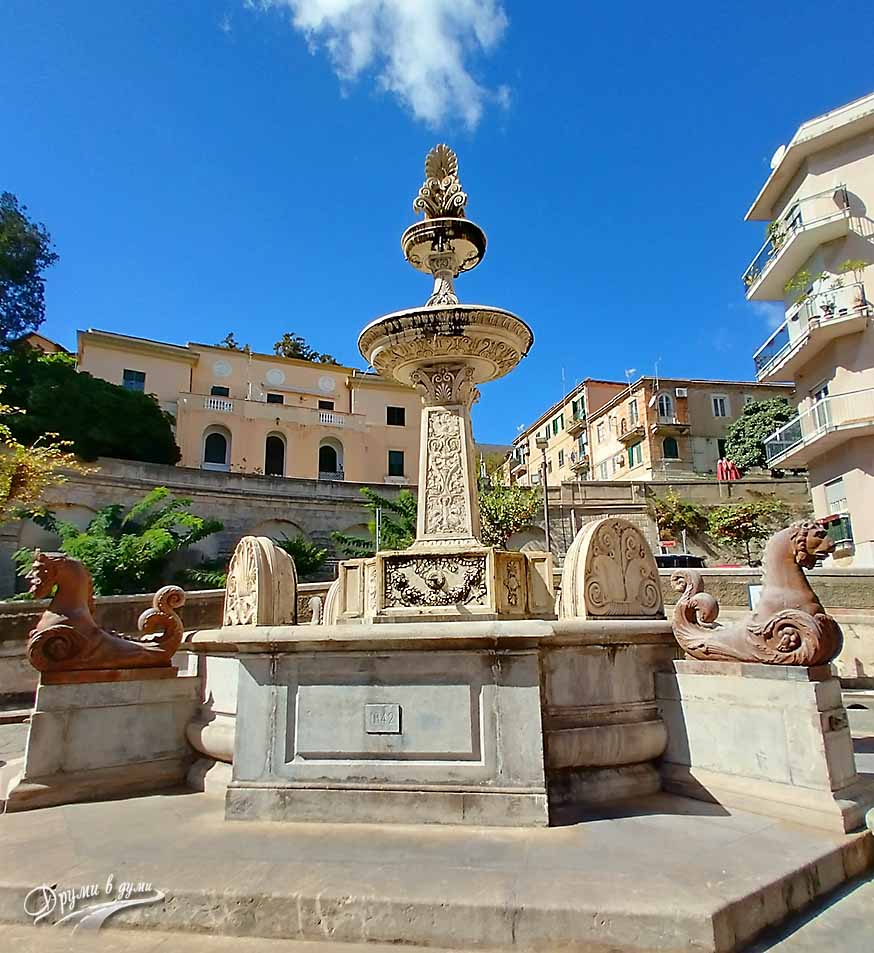
A staircase leads to the church, interestingly decorated with statues of various animals (Scalinata d’arte). At the foot of the staircase there is another curious object – the Falconieri fountain.
Church-Shrine of Christ the King (Sacrario di Cristo Re)
This is another church with a panorama. It is located on the neighboring hill of the church of Santa Maria di Monalto. Its round dome is visible from afar. The current church is relatively new – built in 1937. But once on this hill stood the castle of Rocca Guelfonia (or Matagriffone), which in 1191 sheltered Richard the Lionheart during the Third Crusade to the Holy Land.

Things to do in Messina: interesting tours and experiences
If you want to experience Messina beyond its main sights, there are several interesting tours and experiences that can make your visit even more memorable.
Messina: Sicily excites through wine!
During this experience in Messina, you’ll taste three Sicilian wines paired with a selection of local cured meats, cheeses, jams, and other traditional specialties. It’s a relaxed way to discover the flavors of Messina, enjoying its food and wine culture one sip and one bite at a time.
Messina: Pasta and Tiramisu Cooking Class at a Local’s Home
This Messina tour offers a wonderful opportunity to learn how to make fresh pasta and tiramisu with an experienced local home chef. You’ll also get to enjoy your homemade creations with a Prosecco aperitif and some light snacks.
Messina: Guided Tour of the Puppet Museum
At the Puppet Museum in Messina you will discover the magic of puppet opera and learn about the history of Sicilian puppetry. In addition, you can see over 250 puppets, painted sets and theaters from different periods.
Walking Tour in Messina
This is a guided walking tour in Messina with Local Tours Expert and it follows a route that connects key points of the city’s history, from its medieval origins to its modern reconstruction after the 1908 earthquake.
Final thoughts
What I remember most about Messina are its steep hills, impressive cathedral with its beautiful bell tower, and the wonderful panoramic views from the higher parts of the city. With so many interesting things to do in Messina, the city is definitely worth exploring, although it is not the typical tourist destination in Sicily. For many visitors, it is their first introduction to Sicily, and the city has plenty to offer beyond its busy port.


